
Thank you to our witty and wonderful Poetry Friday host, Matt Forrest Esenwine! Please visit Matt at Radio, Rhythm & Rhyme for this week's round up and a book-anniversary celebration for A Universe of Rainbows.
Today, we welcome Suzy Levinson, children’s poet extraordinaire! She is here to ring in National Poetry Month with us. You can find Suzy on instagram: https://www.instagram.com/suzylevinson/ and at her website: https://suzylevinson.com/

TK: Suzy, so wonderful to talk with you. I first heard your name several years ago when you judged a poetry contest that I entered (with a very forgettable poem!). Our paths crossed again when you co-taught the Lyrical Language Lab with Renée LaTulippe, and nowadays, I see your name pop up in connection with poetry everywhere—including your November interview with Buffy Silverman.
Let’s dive into your latest book: Dinos that Drive!
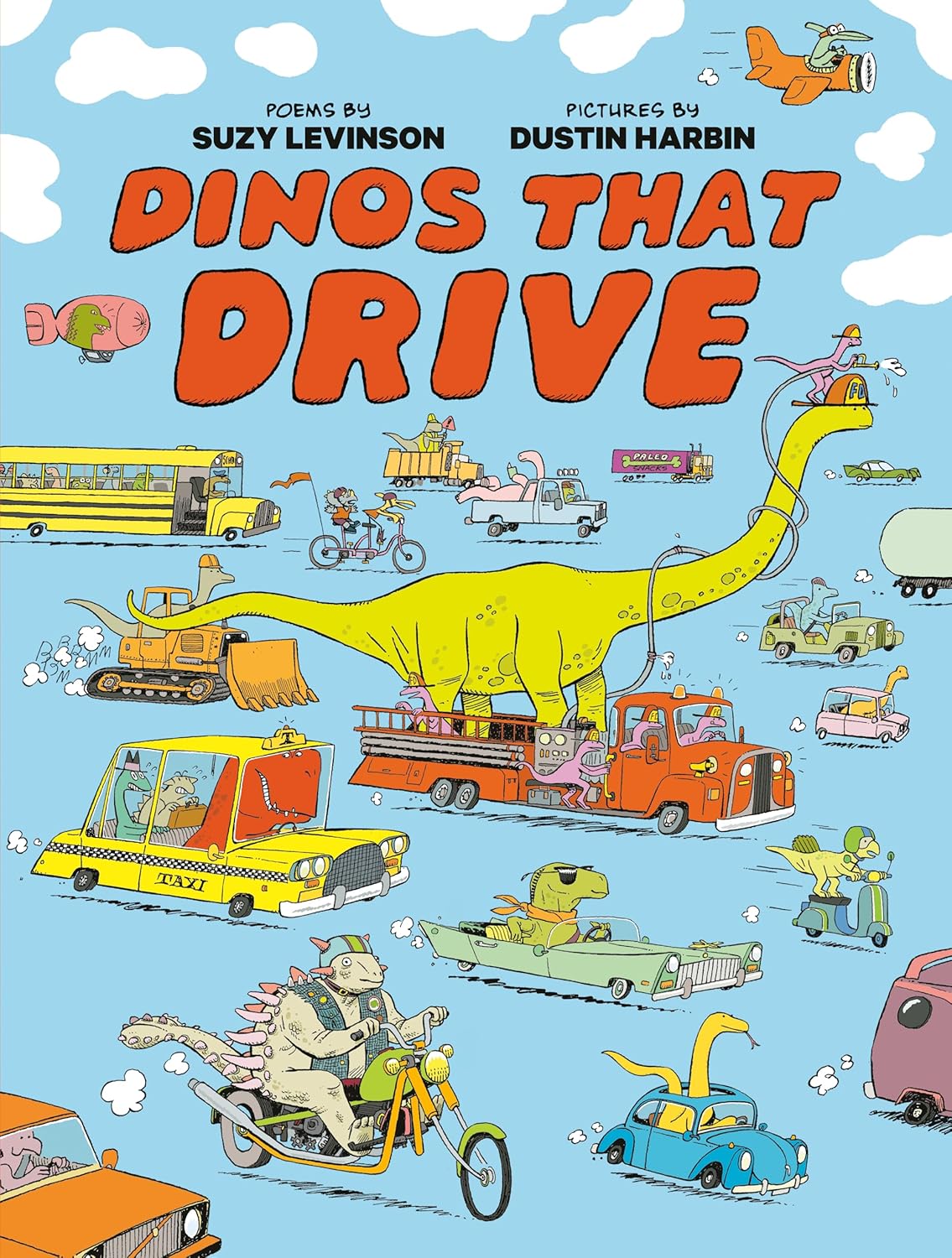
There is so much humor in this collection. The narrators are a riot and the ongoing T. rex bit adds another amusing layer. You are a naturally funny person! Please tell us about your process for incorporating humor into your writing. Does it spill out in the first draft, or do you build humor through revision?
SL: I wouldn’t say I intentionally incorporate humor into my work. Rather, I’ve come to recognize that when I write, funny things just happen, so I lean into that. It’s interesting, because I’m not exactly the class clown in real life. I bet 95% of the people I’ve met would not describe me as funny (although the remaining 5% think I’m hilarious). I guess it’s about feeling comfortable. When I go into creative mode, I just loosen up and worry less. Then I can play around with the element of surprise—which, let’s face it, is at the core of all humor. Carefully setting up the bowling pins, only to zap ’em with a space laser.
I think that’s perhaps the coolest part about writing: discovering and cultivating our own personal strengths. Surprising ourselves sometimes!
TK: KA-POW! Your creativity in action! Wonderful!
Every time I look at Dinos, I pick up another witty tidbit incorporated by illustrator Dustin Harbin. Some of my favorites: Rexxon Future Fuel, the Asteroid Pops ice cream truck, the camping dino reading How to Discover Fire! Dustin used the incongruity between dinosaurs and technology to add even more humor. The illustrations call to mind the detailed drawings of Richard Scarry. Were you surprised by the complexity of the illustrations?
SL: To be real with you, no. I was delighted, but not surprised. I took a good look at Dustin’s portfolio before he agreed to illustrate the book. I don’t remember precisely what I said to my editor, but it was something to the effect of, “If Dustin doesn’t do this project, I’ll die.” He’s a genius. He can draw anything, he’s an awesome world-builder, plus he’s got that dry edge. Long story short, I knew he’d nail it!
As a huge illustration geek, I can’t believe I get to work with such brilliant artists. It’s the best.
TK: It’s a tough choice, but I think my favorite poem in this collection has to be “Iguano-Gone: A Sad Country Song.”
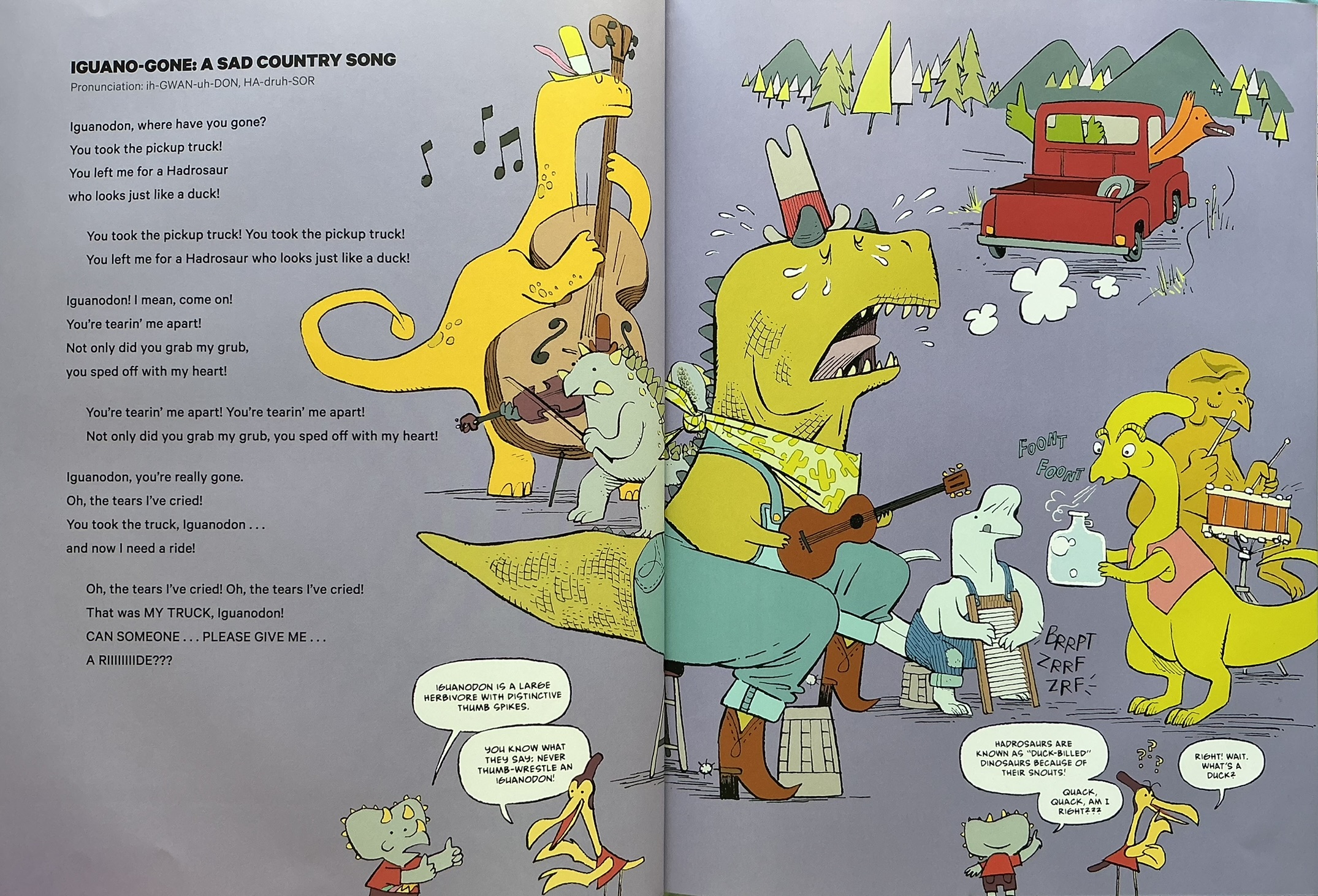
Your creative voice shines through so clearly: “Iguanodon, I mean, come on, you’re tearing me apart!” Which was your favorite poem to write, and which was the most confounding?
SL: “Iguano-Gone” is my favorite, too. It was so fun to write a fake country song—and later work with a musician to turn it into a real country song!
As far as confounding…oh! Maybe not confounding, but there was one downright terrifying moment with “Lots of Aquilops.” I originally wrote the poem thinking that the stress fell on the first syllable (A-quil-ops), when it actually falls on the second syllable (a-QUIL-ops). Thank goodness for the sharp eyes at Tundra Books! When my editor gently pointed out the mistake, I was mortified. I wound up rewriting the poem fairly quickly, but can you imagine if the first version had been published, with messed-up meter?! I’m sweating just thinking about it!
TK: Oof! The rhyming poet’s worst nightmare!
It’s an unfortunate misconception that writing children’s poetry is easy. Aside from the technical aspects of writing poetry, I imagine you also had to do a lot of dino research. What was the most challenging aspect of creating this collection?
SL: I think the most challenging aspect was getting over the intimidation factor, right at the start. I knew the collection was only going to work if there was some weird internal logic to it, so that meant research—just one trait connecting each dino to each vehicle, but still daunting! Plus, I knew that incorporating dinosaur names like Pachycephalosaurus into metrical rhyming verse might be a smidge tougher than, say, cat.
But at some point, fun outweighed intimidation—for instance, when I learned that Brontosaurus’s name means “Thunder Lizard,” the perfect biker name, I couldn’t resist at least trying to write this thing.
TK: What were some differences in your writing journey to create Dinos and that of writing your earlier collection Animals in Pants?
SL: Oh, I learned so much from Animals in Pants! For that one, I mostly focused on writing enough poems to make up a full collection. It was only after I sold it that my editor at Abrams/Cameron Kids quite rightly suggested that it needed more structure, which hadn’t even occurred to me. The book was never going to have a traditional story arc, but I was able to give it a bit more shape by adding a simple intro and outro, plus shuffling poems around. Lots of trial and error before we had the final product (which I love).
It was because of that experience that I was far more intentional about structure while writing Dinos that Drive. From the get-go, I included intro and outro poems. I clustered the poems more strategically. I peppered the four short T. rex poems throughout the collection, to serve as a bit of a refrain while also building momentum. Even the two little fact-spouting sidebar dinos, who came later in the process, contribute to moving things along as they chat away.
But of course, the biggest difference between the two collections was the inclusion of facts in Dinos that Drive. Totally unavoidable. While there was no need for me to explain dogs sleeping or kangaroos jumping in Animals in Pants, it would’ve felt pretty odd for me not to explain why certain dinos migrate or swallow rocks.
TK: Without giving away too much, can you talk about how you came up with the idea for Dinos’ unexpected ending?
SL: The ending’s fun, right? I love dry humor in children’s books, but I also love hope and heart. So how was I going to imbue the ending with hope and heart when dinosaurs went extinct? And how was I going to do that while also mentioning driving? In rhyme? It seemed almost impossible, but hey, that’s the beauty of writing with constraints; sometimes if you give yourself enough problems, you wind up with only one solution!
TK: How can people get a copy of Dinos that Drive?
SL: I hope you’ll all pick up a copy of Dinos that Drive, wherever books are sold! Here are some options on my website. And if anyone wants a signed bookplate, just message me and I’ll pop one in the mail, easy-peasy.
TK: Thank you for that kind offer and for spending this time with us and sharing your wonderful journey to create Dinos that Drive, Suzy! We wish you great success!
SL: Thanks, Tracey! Happy National Poetry Month!